



 Services
 Roof Systems
 Property Types
 Industries
 Damage Repair
 Capabilities
 Manufacturers
 Service Areas
Wind Damage Roof Repair in Alexandria, VA
Roof Damage Repair:
- Wind Damage Roof Repair in Alexandria, VA
- Ponding Water Roof Repair in Alexandria, VA
- Commercial Roof Flashing Failure Repair in Alexandria, VA
- Commercial Roof Seam Failure Repair in Alexandria, VA
- Commercial Roof Membrane Puncture Repair in Alexandria, VA
- Commercial Roof Fire Damage Repair in Alexandria, VA
After a wind event, a loose edge or lifted flashing can let rain beneath a roof even when the membrane still looks continuous from the ground. We inspect the perimeter, seams, penetrations and nearby interior areas, then mark what can be verified. Alexandria, VA faces occasional hurricane exposure and intense rainfall, so attachment and drainage both matter in the review. That context does not prove a specific roof sustained damage; the inspection ties the finding to an address and detail.
Carlyle and Eisenhower East include WMATA’s office building on Mill Road, while Duke Street leads toward Landmark/Van Dorn. These are distinct local settings, and neither gives us the roof assembly at a service address. The building's location does not establish its roof system or storm condition. We confirm access, assembly and the reported event before proposing work. Flashing failure and open seams can admit water through different details, so each suspected path is inspected separately.
Wind Damage Roof Repair
Inspect Edges Before the Leak Travels
Wind can place stress at roof corners, perimeters, laps, curb flashings and metal terminations. We check for lifted membrane, loose fasteners, displaced coping, torn flashing and debris impact. A commercial roof inspection includes photographs and a field sketch that show the affected zone and adjacent details. The report distinguishes visible movement from areas that need closer access or testing.
We inspect the membrane around the suspected point rather than treating a loose edge as proof that the entire roof has lost attachment. Where safe and accessible, attachment and seams are reviewed along the likely wind path. We note whether water has entered, whether insulation may be involved and what remains hidden. A test opening can confirm layers at a selected point after the owner approves the location and interior protection.
Wind-related damage can overlap with older wear or prior repairs. We compare exposed surfaces, nearby terminations and repair boundaries, and record the date and conditions reported by the property. The roof evidence may support a localized correction, more investigation or a larger scope. The written record avoids assigning a storm cause to a condition that cannot be tied to the reported event.
Control Water While Scope Is Prepared
For a building with active water entry, crews can respond day or night, including holiday and weekend periods. We assess whether temporary protection can reduce exposure without concealing the suspected source. Any temporary measure is documented with its location, limits and follow-up needs. A temporary cover is not the permanent repair, and the roof should be revisited when conditions allow a full inspection.
The owner or manager identifies occupied areas, equipment, inventory and routes below the damaged detail. We coordinate a safe work boundary, lift or ladder access, and any temporary restriction below. If a loose panel or edge creates a falling-object concern, the perimeter is controlled before roof work proceeds. The site contact confirms the approved access and any security or public-route requirements.
For properties near Carlyle, delivery and staging conditions should be checked at the actual address. The same is true near Landmark/Van Dorn, where Duke Street and Van Dorn Street organize a regional corridor. We confirm access with the property contact instead of assuming a neighborhood provides a staging area.
Match the Repair to the Roof Assembly
Before selecting materials, we identify whether the roof uses TPO, EPDM, modified bitumen, built-up roofing or metal. Wind can expose different failure points on each assembly. A compatible patch may be suitable if material around the damaged area remains sound; widespread separation or compromised attachment can require a larger boundary. We inspect substrate, insulation, edge construction and drainage before comparing repair with replacement.
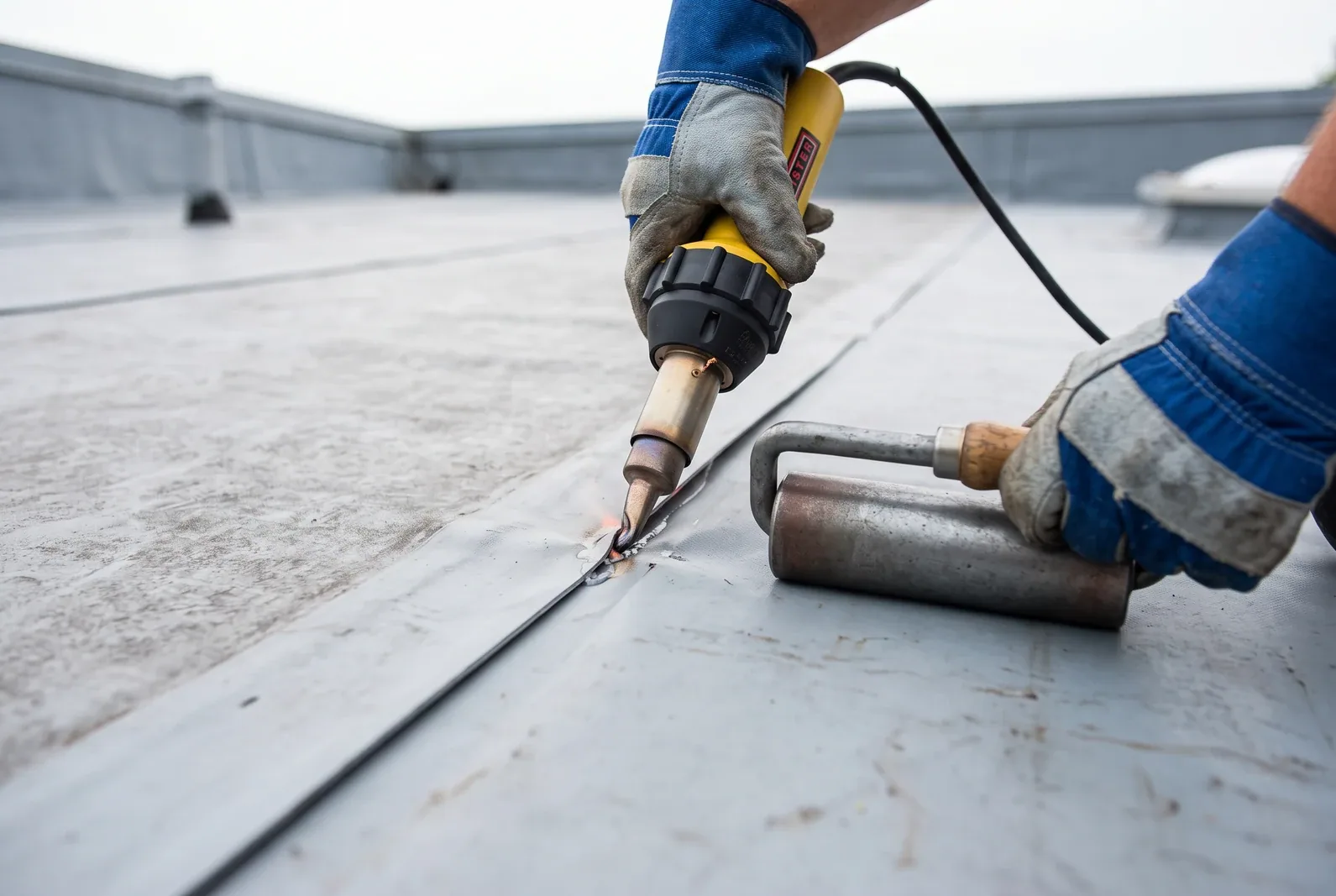
A TPO membrane needs compatible heat-welded repair details; EPDM and metal require different preparation and movement allowances. We describe the repair location, fastening or flashing work and adjoining transitions. If rooftop equipment is involved, we check curb and support details so movement at the equipment interface is not left outside the repair scope.
If wind displaced edge metal or opened a wall transition, the scope should include the substrate and fastening condition as well as the visible metal. A drainage repair is separate unless inspection also identifies a water-retention issue. The proposal lists confirmed items and any allowance or further testing needed before concealed damage can be included.
Give the Owner a Reviewable Record
We provide dated photographs, zone labels, a description of observed movement and a repair boundary. If testing is performed, the record identifies the point and what was found there. If a section was inaccessible, that limit stays visible. An insurance documentation review can organize roofing observations and photos for the owner’s claim process, while coverage remains with the insurer.
After repair, we document the completed attachment, flashing or seam work and any remaining condition. If a larger replacement is considered, the owner can compare it with the measured correction using the same roof-zone information. Maintenance visits can return to exposed edges, drains and prior repair points after future weather events. We record the change at the same locations so the owner can compare movement, water entry and completed corrective work over time.
Send the Alexandria address, the date and type of reported wind event, photos if available, and the person who can authorize roof access. We will inspect the exposed details and provide a repair scope based on what the roof evidence supports.
Inspection should start at the perimeter, corners, terminations and rooftop equipment, where attachment and transitions may respond differently from the open roof field. We photograph loose metal, displaced membrane, exposed fasteners and nearby seams separately, then compare those findings with interior reports and earlier repair records. Missing material is not the only evidence of movement; a lifted edge can reopen when wind pulls against the next secure section. The repair boundary follows the connection that failed and identifies sound material for the tie-in. If safe access limits what can be checked, that roof zone remains a separate follow-up rather than being assumed intact.
Roof Damage Repair
Commercial Roofing Questions
How soon should a roof be inspected after strong wind?
Inspect promptly when there is active water, loose material or a change visible from a safe location. Do not climb onto an unsafe roof. We can assess the accessible perimeter and suspected details, document temporary protection and return for a full inspection when weather and access allow.
Does a lifted edge mean the full roof needs replacement?
No. We check how far the attachment or membrane condition extends and whether adjacent areas remain serviceable. The report identifies confirmed limits and any testing needed before a larger scope is proposed. A localized correction can remain appropriate when evidence supports it.
Can you document wind damage for an insurance review?
We can provide dated photos, measurements, roof-zone references and a description of observed conditions and repairs. The insurer evaluates policy coverage and causation. Our record stays focused on roofing evidence and any limits of the inspection.
What should be done if rain is entering through a loose roof edge?
Contact the property representative and keep people clear of any unsafe area. We can assess immediate protection and document the suspected entry point. Temporary work should be identified separately from permanent repair so the affected detail can be inspected once conditions permit.
Which parts of a roof are checked after wind?
We inspect perimeters, corners, seams, penetrations, curb flashing, coping and nearby drainage. The exact path depends on the assembly and reported conditions. The report shows which zones were accessed and what could not be confirmed without further testing.
Inspect Wind-Exposed Roof Details
Share the property address, reported event, affected area and access contact. We will document the roof condition and outline a measured repair plan.