



 Services
 Roof Systems
 Property Types
 Industries
 Damage Repair
 Capabilities
 Manufacturers
 Service Areas
Commercial Roofing for School Districts in Alexandria, VA
Industries We Serve:
- Commercial Roofing for Property Management Companies in Alexandria, VA
- Commercial Roofing for Real Estate Investors and REITs in Alexandria, VA
- Commercial Roofing for Healthcare Systems in Alexandria, VA
- Commercial Roofing for Manufacturers in Alexandria, VA
- Commercial Roofing for Logistics and 3PL Operators in Alexandria, VA
- Commercial Roofing for School Districts in Alexandria, VA
A roof leak in a classroom may begin at a distant drain or flashing transition, then move across the deck before staining a ceiling. School facility teams need the water route, affected rooms and access boundary before deciding what work fits a break or occupied term. We inspect roof details and document the area that can be verified. Alexandria, VA has intense rainfall, summer heat and winter freeze-thaw, conditions that make drainage and seams worth checking without assuming a school roof has failed.
Each campus has its own student calendar, roof plan, access rules and facility contact. We confirm those details before setting the inspection route or proposing a work window. The inspection route follows the affected classroom or wing, with a protected observation point below any proposed test opening. Public agencies can coordinate procurement, while healthcare systems face similar needs for occupied-building protections.
School Districts
Fit Work to the Academic Calendar
The district identifies school days, testing periods, summer programs, custodial access, athletics and emergency routes before work is scheduled. We plan roof entry, deliveries and noisy tasks around those limits. Emergency response is available all hours, including holidays and weekends, for active leaks. The permanent repair still needs an approved campus window and a safe way to protect classrooms or other occupied areas below.
Summer break does not make every building available. Some campuses host programs, staff training or construction, while equipment access may be restricted by playground, bus and delivery activity. The facilities contact confirms when a roof zone and staging area can be used. The schedule identifies daily start and stop conditions, including how an open section is made weather-tight at the end of a shift.
For occupied work, we coordinate ceiling access, barriers, debris, noise and routes below with the school representative. A lift or container should not block buses, fire access or student circulation. If work must happen during the school year, the scope can limit the active zone and identify any temporary room restriction for the facility to approve and communicate.
Trace the Leak Before Scoping Work
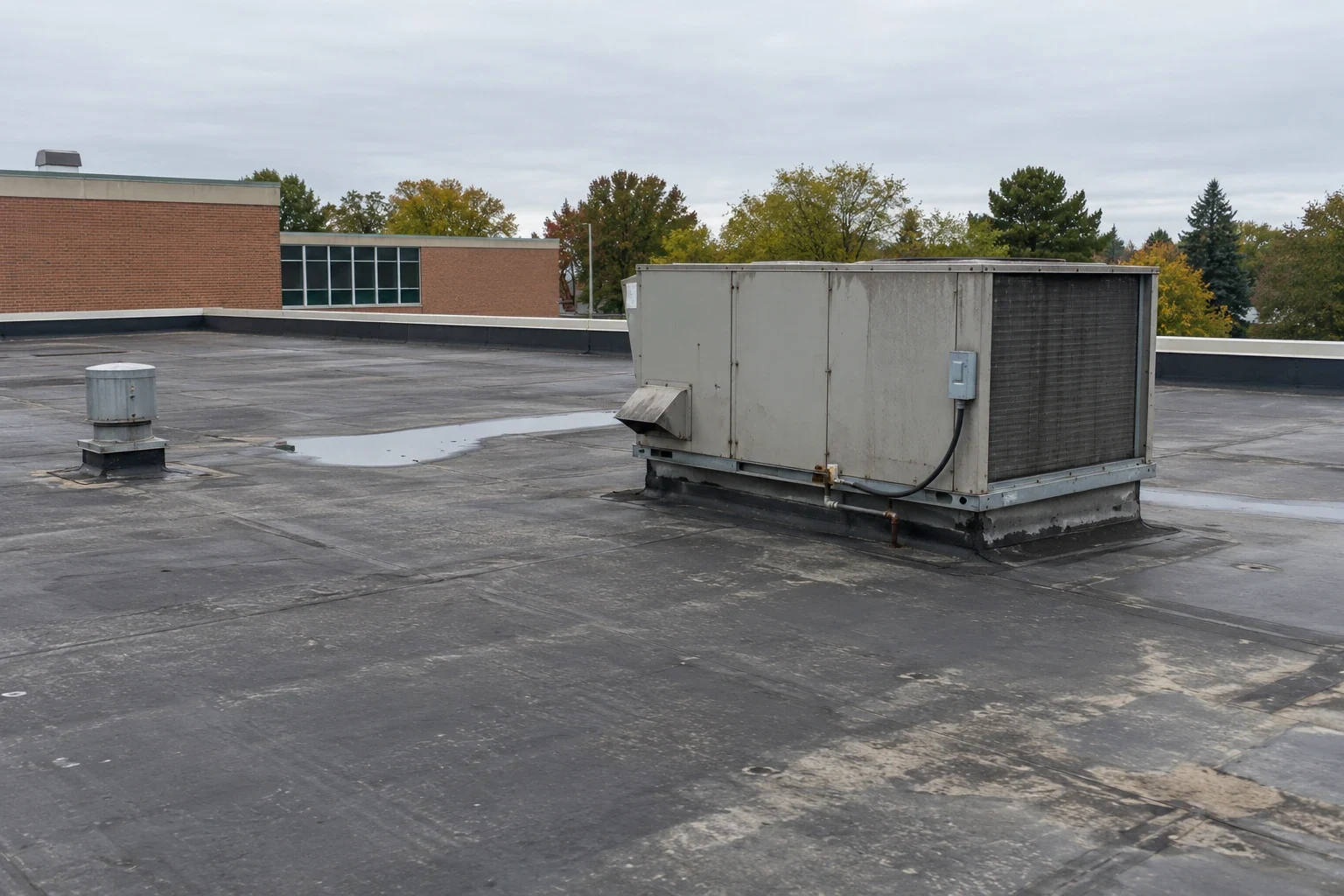
We compare the reported classroom, gym or office with roof slopes, drains, seams, curbs and wall transitions. A commercial roof inspection records the likely entry area separately from the interior symptom. Photographs and a field sketch let district staff connect observations to a wing and roof section.
Drains and scuppers are checked for blockage, slow discharge and water marks. At seams, we inspect for separation or incomplete welds; at penetrations, we check the flashing and support details. A flashing repair addresses a failed transition when evidence supports that diagnosis, but it does not correct a separate drainage problem.
Moisture below a membrane may require testing. An infrared reading can help choose where to look, but roof construction and weather affect its meaning. With school approval, a controlled test opening can confirm layers and deck at a selected point. We coordinate the observation below, protect the room and document restoration. The result applies to that location unless additional checks support a broader finding.
Use the Material Already Installed
A school building's name or age does not tell us its membrane. We review plans and field details to identify system, attachment, insulation, deck, drainage and perimeter transitions. A localized repair can remain small when surrounding material is serviceable. If moisture extends beyond the visible defect or attachment is deteriorated, a larger boundary may be needed.
TPO, EPDM, modified bitumen and metal roofs have different seam and flashing details. A TPO roof is repaired differently from an modified-bitumen roof. We confirm the installed system before selecting materials. If replacement is appropriate, the scope identifies removal, insulation, edge work, drainage and protection below rather than listing only the membrane.
A phased reroof can separate buildings or roof zones to limit disruption, if the assembly and calendar allow it. Each phase includes a clear work area, equipment route and closure method. The district can compare a repair, recover or replacement scope against its funding window and classroom schedule. A recover is considered only when existing materials and project criteria permit another layer.
Plan for Local Rain and Freeze-Thaw
Intense rainfall tests drains and overflow paths. Summer heat adds movement at exposed details, while freeze-thaw can stress seams and joints that remain wet. We check the roof for these mechanisms and record what is found on site. A weather pattern is context for inspection, not proof of ponding or damage at an individual campus.
Material installation has requirements for surface condition and weather. If rain interrupts removal, the work zone must be protected and closed as planned. We coordinate each shift with facilities staff, including who verifies that doors, pathways and rooms below are ready to return to service. The plan can move to another approved roof zone if weather or school operations close the first one.
Near Potomac Yard, development and transit activity can affect delivery and staging, while Landmark/Van Dorn has different site access. For a campus near Potomac Yard, the district contact confirms current delivery points and campus restrictions. The small-area plan does not replace a review of the school entrance, roof access and active schedule.
Make Campus Findings Easy to Use
We provide dated photos, roof-zone labels, repair notes and remaining questions in a record the facilities team can retain by school. A roof condition report can help compare work orders, while each page of the record keeps conditions tied to the inspected building. Areas not reached or tested remain clearly marked.
Preventive maintenance can revisit drain bowls, seams, edge metal, penetrations and prior repairs before water reaches classrooms. The inspection interval should fit the roof condition and school access requirements. If a district is planning broader work, we can identify which observations call for immediate attention and which need a separate capital decision.
Provide the campus address, affected room, roof records, academic calendar and facilities contact. We will inspect the relevant area, coordinate protection and prepare a repair or phased project plan for district review.
Industries We Serve
Commercial Roofing Questions
Can roof work be completed while students are in the building?
It can be possible when the facility approves the roof zone, routes, barriers and work hours. We identify noise, debris, ceiling access and protection below so the district can decide whether nearby rooms stay open. Some work may need a temporary restriction or a different calendar window.
Should a district wait for summer to repair a roof?
An active leak should be assessed when it occurs, regardless of the academic calendar. The repair schedule depends on weather, access and the building's condition. We can identify immediate protection and then plan permanent work for an approved period if operations require a later installation window.
How do you keep one test opening from disrupting a classroom?
The facility approves the location and observation point first. We coordinate barriers, ceiling access, cleanup and restoration, then keep the opening within the agreed area. If the school cannot protect that room at the proposed time, we select another approved test point or method.
What should a school report when a ceiling becomes wet?
Share the room, time, weather, photos and whether moisture is active, along with any roof access or student-safety limits. Facilities staff can note equipment or drains above if known. We use the report to identify candidate roof zones, then verify the source on site.
How can a district compare roof needs among campuses?
Use records that identify each building, assembly, roof zones, photographs, repairs and untested areas. We can organize findings by urgency and access needs, while preserving differences between campuses. One school's leak history should not be used to infer another roof's condition.
Schedule a School Roof Inspection
Send the campus address, affected room, access contact and calendar limits. We will trace the roof condition and prepare a protected work scope for district review.