



 Services
 Roof Systems
 Property Types
 Industries
 Damage Repair
 Capabilities
 Manufacturers
 Service Areas
Infrared Roof Moisture Survey in Alexandria, VA
Commercial Roofing Services:
After sunset, wet insulation can release heat differently from dry material, creating a thermal pattern worth checking. An infrared roof moisture survey uses that contrast to identify areas for follow-up, not to declare every warm or cool spot wet. We schedule the scan when roof conditions support useful readings, map temperature patterns by roof zone and open selected areas to inspect the layers. For a general contractor in Alexandria, the value is a defensible boundary before pricing insulation removal or a larger repair.
The method is most useful when the roof assembly and recent weather allow the surface to respond clearly. Carlyle office and mixed-use buildings and the institutional development at North Potomac Yard can have broad roof areas, multiple equipment zones and limited access windows. The address, roof assembly, surface condition and repair decision determine whether an infrared survey fits the project. A hands-on roof inspection can identify visible defects and help select locations for thermal follow-up.
Infrared Roof Moisture Survey
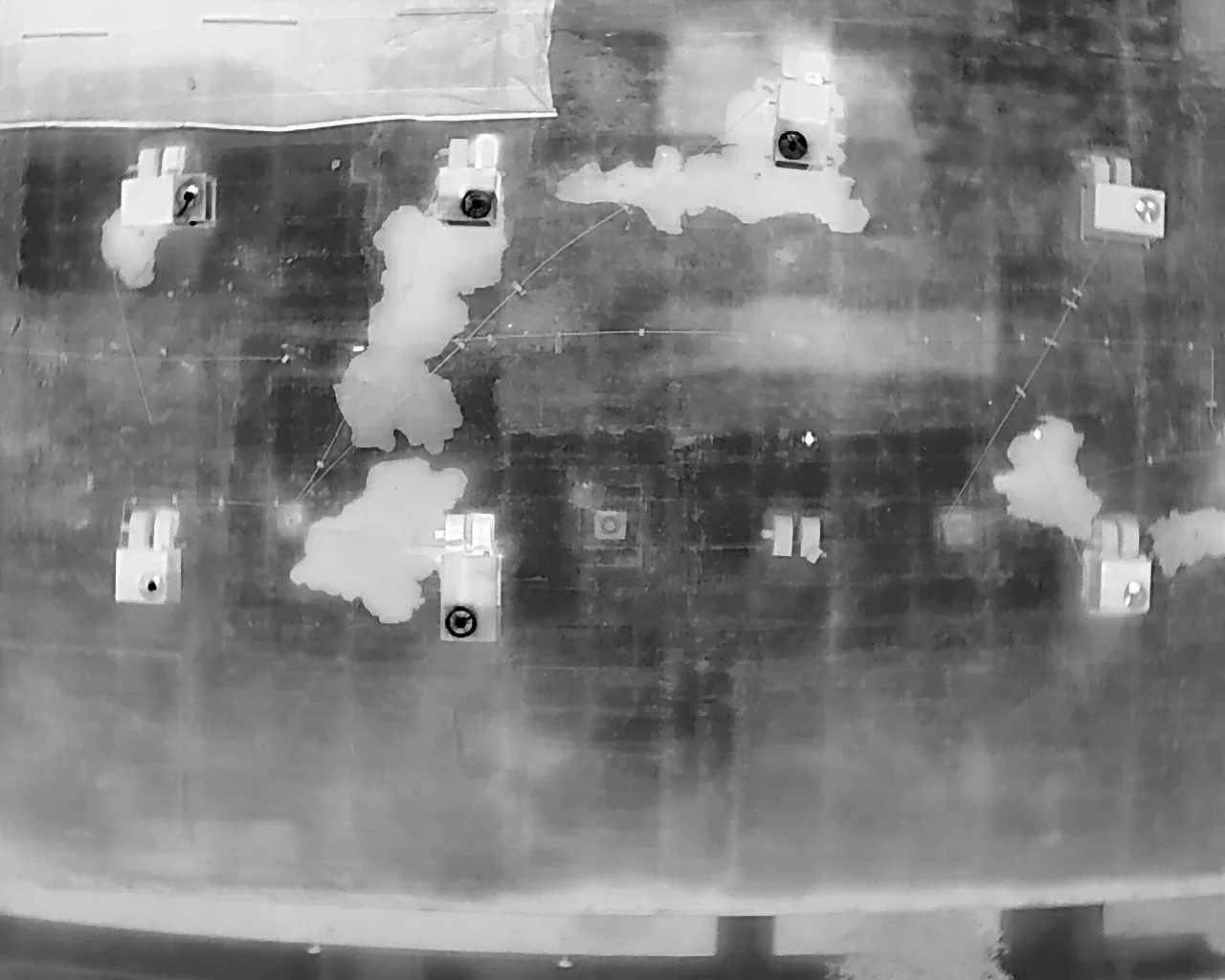
Read Patterns, Not Labels
Infrared cameras measure surface temperature differences. The camera reads surface-temperature differences; it does not see through the roof or measure water directly. A thermal anomaly may correspond to moisture, but shading, rooftop equipment, changes in insulation, repairs, wind and surface materials can also create a contrast. We map the pattern and compare it with roof geometry, drains, seams and visible conditions. The map highlights areas for closer inspection, while test openings show concealed material condition.
Timing matters. During a suitable evening scan, roof areas may cool at different rates as stored heat leaves the assembly. Recent rainfall, cloud cover, wind, surface moisture and solar exposure can affect the contrast. Recent rain, wind or cloud cover can weaken thermal contrast, so reschedule when the pattern cannot be read clearly. We explain the conditions used and any limit that affects the map rather than presenting an ambiguous reading as a confirmed wet area.
Plan a Useful Scan
Before surveying, we review available roof plans, prior repairs and the question the owner needs answered. A moisture boundary for a repair estimate differs from a broad condition map for capital planning. Mark known membrane areas, drains and rooftop units, and arrange access for any test opening after the scan. Multiple roof layers and older repairs affect where a test opening will best answer the moisture question.
We inspect visible conditions during the site visit and map the roof into labeled zones. Anomalies receive coordinates or a field reference that lets the crew return to the same location. We record nearby curbs, parapets, drains and equipment that may influence readings. Where a thermal pattern follows a wall shadow or rooftop unit, it may need a different interpretation than an isolated area within an open roof field.
Access can shape the plan. An occupied building may require a designated contact, roof key, escort or a separate work window for test openings. Around Eisenhower East, office properties along Eisenhower Avenue and Mill Road can have active building operations. Coordinate the scan timing with any return visit for test openings or repair. A survey in Eisenhower East should use the specific building contact and not assume a district-wide access process.
Confirm the Anomaly
Test openings turn a thermal observation into physical evidence at selected points. We cut only where the scan and surface review make the check useful, then inspect the layers for moisture and identify the insulation condition. A dry test opening identifies conditions at that point; additional areas may need sampling if their thermal patterns differ. A wet opening confirms conditions at that location and helps determine how far the material removal boundary should extend.
The report shows the opening position, roof layers, moisture observations, photos and repair recommendation. If several anomalies appear, the owner can prioritize representative checks rather than opening every mapped area without a plan. The number and location of test cuts depend on roof layout, access, the expected repair and how much uncertainty affects the decision. Close each opening with a compatible repair and include its location in the closeout.
Drainage and flashing conditions remain part of the interpretation. A thermal anomaly near a drain may point to water held in the assembly, but a clogged strainer or a transition defect can also be relevant. Alexandria’s tidal Potomac and heavy-rain exposure make overflow paths worth recording during the visit. Inspect surrounding details separately, since the area holding moisture may differ from the entry point.
Set the Repair Boundary
Once selected openings are checked, we can compare the thermal map with confirmed material conditions and visible roof defects. The repair boundary should reach sound, dry material where removal is recommended. The scope identifies insulation replacement, membrane tie-in, flashing work and any separate drainage correction. If a test opening finds dry material, do not include that location in wet-insulation removal quantities.
Timing and cost depend on scan conditions, access, test points, assembly layers and the area confirmed. The proposal separates survey, test openings and repair so the owner can authorize each stage as needed. Where testing finds a broad condition, a larger replacement comparison may be appropriate alongside a localized repair option.
Virginia Tech’s North Potomac Yard campus focuses on computing, data sciences, security and technology policy, and the district also includes approved office blocks. A survey on an institutional property needs clear access coordination and a record that distinguishes the building contact’s limits from roof findings. Alexandria construction applicants use the 2021 Virginia Codes; requirements for corrective work depend on its scope and project review.
Make the Findings Reusable
The final record can include annotated thermal images, a roof-zone map, environmental records, confirmation points, test-opening photos and repair limits. A clear report explains which areas were scanned, which were opened, what each opening showed and what remains unverified. That helps a future estimator revisit the same evidence and gives the owner a basis for maintenance, repair or capital planning.
If an infrared survey is part of a leak call, we connect the confirmed moisture area with the suspected entry point and keep those findings distinct. The place where water is retained may not be where it entered. An accompanying leak investigation can trace seams, penetrations and drainage transitions. For broader follow-up, a condition report can combine the thermal map with hands-on observations and planned work.
Commercial Roofing Services
Commercial Roofing Questions
Does an infrared scan prove an area is wet?
No. Thermal imaging identifies temperature patterns that may indicate moisture, but shading, equipment, repairs and surface conditions can produce similar contrasts. We select representative locations for test openings and report the physical findings separately. The scan points to areas for testing; the opening helps set a removal or repair boundary.
What weather is needed for a roof moisture survey?
The roof needs conditions that allow different areas to cool or retain heat in a readable pattern. Recent rainfall, cloud cover, wind and surface moisture can change the result. We assess the forecast and roof exposure, then state the conditions at survey time. If the contrast is unreliable, postponing is more useful than forcing an interpretation.
How many test openings will you make?
The number depends on roof layout, thermal patterns and how much uncertainty affects the repair decision. We select points that can confirm or challenge the mapped areas, then expand testing only when the findings justify it. Each opening is photographed and repaired; the proposal shows how the findings affect the removal boundary.
Can infrared identify where a leak starts?
A scan may show where moisture is present, which can differ from the entry point. Water can travel beneath the membrane before it reaches the assembly area that holds moisture. Inspect nearby seams, curbs, walls and drains; trace the leak separately when its entry point remains unclear.
When should we use infrared instead of a drone?
Infrared is suited to a question about possible concealed moisture when survey conditions support thermal contrast. A drone is better for broad visual mapping, roof geometry and difficult access. When both questions matter, imagery maps the roof and thermal testing targets areas for a physical opening.
confirm Moisture Before Setting Scope
Provide the Alexandria address, known roof assembly, recent leak history, available plans and access limits. We will assess whether conditions support infrared mapping and identify any test openings needed to set a repair boundary.