



 Services
 Roof Systems
 Property Types
 Industries
 Damage Repair
 Capabilities
 Manufacturers
 Service Areas
Standing Seam Metal Roofing in Alexandria, VA
Roof Systems:
Summer heat moves long metal panels, and winter cold draws them back. The selected standing-seam and attachment arrangement accommodates the movement designed for that panel system; its clips and fixed points need examination before repair. In Alexandria, that movement meets heavy rain, occasional snow and freeze-thaw at edges, curbs and drainage points. We inspect panel runs, clip behavior, penetrations and flashing transitions, then mark what can be repaired and what needs a larger scope.
Office and mixed-use buildings in Carlyle and Eisenhower East sit among redevelopment properties, while Old Town North combines retail and commercial uses with the former power-station site’s redevelopment. A district name does not identify a roof system. Plans and panel profile guide the inspection. We compare the assembly with a metal roof retrofit or TPO system only when condition and project requirements support it.
Standing Seam Metal Roofing
Follow the Panel Run
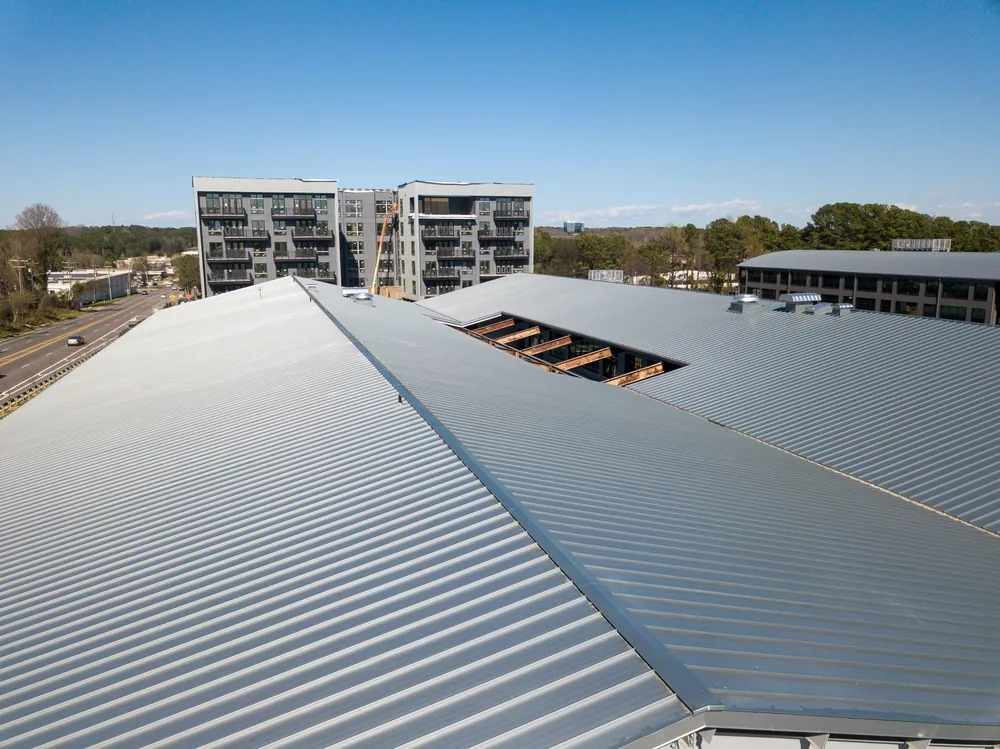
A long panel needs room to expand and contract. The clips and fixed points are assessed against the panel system's designed movement; an unsuitable restraint or damaged component can stress a seam or penetration. We trace the panel from eave to ridge and look for oil canning, buckling, slipped seams, pulled fasteners and distortion around equipment. These observations direct closer movement and attachment checks rather than establish the failed component by appearance alone.
Standing seams join adjacent panels above the main drainage plane. We examine seam engagement, laps, end conditions and any evidence that water has crossed the raised joint. A seam that looks closed from the ground may have a damaged clip or poor termination below. Roof access lets us record the profile, panel width, slope and condition at each roof zone before the repair method is selected.
At curb corners and pipe penetrations, cut panels and flashing must allow movement without opening a water path. We inspect the boot or metal transition, sealant, fasteners and nearby seam. A rigid patch can restrain a moving panel, so the repair needs compatible material and a detail that preserves the designed movement. The estimate identifies whether the defect is isolated or repeated across the run.
Trace Water to the Eave
Standing seam panels usually shed water down the slope, but the eave, valley, gutter and wall termination decide where runoff goes next. We follow that route for debris, backed-up water, damaged closures and overflow marks. Intense rain makes roof outlets and overflow routes useful inspection points, while Alexandria's tidal flooding is assessed separately where it affects ground discharge or site access. We report observed roof conditions separately from ground-level flood concerns.
Snow and ice can hold moisture at eaves and interrupt drainage while temperatures move above and below freezing. Washington National Airport's 1991-2020 normals give a January average low of 30.1°F and normal monthly snowfall of 4.9 inches. At the roof, we inspect eave edges, valleys, gutters and snow-retention details for loosened metal, water staining or movement.
A blocked gutter can back water toward a panel termination. We check the outlet and edge metal, then note whether a drain and scupper review is needed. If water appears inside, compare that location with the roof zone during a leak investigation.
Check Coatings and Fasteners
Metal roofs can show corrosion where protective finishes are cut, scratched or held wet. We inspect finish loss, rust at panel edges, fastener heads, sealant, dissimilar-metal contact and debris traps. A coating may slow surface deterioration when the substrate is sound and prepared correctly. It does not restore a failed clip, close a moving seam or make a wet assembly dry. A coating restoration scope must name the preparation, repairs and areas that will remain outside the coating.
Exposed fasteners, if present at trim or older repairs, need attention to washer condition and hole enlargement. A loose screw can admit water or lose holding strength, while over-tightening can deform a panel. We record representative locations and determine whether the defect is a localized maintenance item or a pattern that requires broader evaluation. A commercial roof inspection can document these conditions with photos and a roof-zone sketch.
When deck or underlayment condition is unknown, an approved test opening can compare visible layers with leak history. Metal can conceal wet insulation or interface corrosion, so surface appearance does not establish the full assembly’s condition.
Set a Repair Boundary
A loose seam, failed closure or isolated flashing defect can often be scoped as a measured repair after the surrounding metal is checked. The plan identifies panel limits, trim, fasteners, sealant or replacement pieces, plus any access and safety controls. If several adjacent panels have shifted or corrosion follows a broad area, we compare repair with panel replacement or a larger system change. A recommendation should say which finding set the boundary.
Some owners consider installing a new assembly over an existing metal roof. That decision depends on attachment, substrate, added height, drainage details, building loading and project code review. The recover assessment should establish what stays, whether the existing assembly is suitable and how edges, curbs and terminations will be handled. Concealed conditions that have not been opened remain a stated uncertainty.
Alexandria construction applicants use the 2021 Virginia Codes. Design and permit requirements depend on scope, drawings and existing conditions, so we coordinate assembly details with the project team and code review.
Plan Work Around Operations
Panel replacement brings noise, deliveries and periods when a roof zone is open. The GC and property contact set staging, tenant notices and protection below. Eisenhower East offices and redevelopment use Mill Road and Eisenhower Avenue; confirm access for the address.
We select manageable roof zones and plan their stopping connections and suitable temporary protection against the crew, preparation and weather conditions before removal begins. A forecast matters because a partially opened panel run can expose the deck. Schedule includes product requirements, measurements, fabricated trim and approved test openings. Emergency response is available around the clock, including holidays, when an active opening or sudden leak cannot wait for a regular work window.
Cost and timing follow panel length, profile, access, flashing count, substrate condition, removal, disposal and the amount of trim that must be fabricated. We separate known repairs from concealed conditions and provide an approval point before added work. That gives the GC a scope that can be coordinated with other trades rather than an allowance with no roof-zone limit.
Leave a Useful Record
Closeout photos should show the repaired seam, clip or panel, its adjacent transitions and the water route to the outlet. We list materials, replaced pieces, test locations and areas not opened. The record helps a future manager distinguish original panels from later repairs and identify where inspection should resume.
For a commercial property near Old Town North or North Potomac Yard, keep the record specific to the address. A condition report organizes defects and follow-up by zone. Share plans, leak notes and access limits when requesting a review so the inspection can test the right panel runs.
Roof Systems
Commercial Roofing Questions
Can a standing seam leak at a seam that looks closed?
A clip, end lap, termination or penetration can fail while the raised joint still looks engaged. We inspect the panel profile and nearby details, then recommend a controlled opening only when its result will guide scope.
What makes a metal panel buckle between seams?
A fixed clip, poorly placed fastener, tight penetration or incompatible detail can restrict panel movement. We trace the distortion to its ends and attachments before recommending a correction. Buckling alone does not identify the part to replace.
Can you coat standing seam metal instead of replacing it?
Coating is a candidate when the metal is sound, corrosion is limited, and seams, fasteners and flashing are repaired first. We specify preparation, adhesion checks and excluded areas. Coating cannot correct movement or concealed wet insulation.
Does a standing seam roof need snow guards?
Placement follows slope, panel type, entry routes and snow-control design. We inspect existing attachments before adding hardware, since a seam-damaging attachment can create a leak path. Drawings and building use guide placement.
What information helps scope a panel repair?
Send the address, panel profile if known, plans, leak locations, repair history and access window. Photos help locate a roof zone, but an on-roof review confirms seam, clip and flashing condition.
Review Standing Seam Roofing in Alexandria
Share the Alexandria address, panel information, reported leak area and access constraints. We will trace the water path, inspect attachment and flashing, and define a repair or replacement boundary.